
UMZAR international commercial timber classifier
UMZARUMZAR
Scientific database · Data Science · registered IP

International certification ofcommercial timber

A registered database that standardizes commercial timber information through physical and mechanical properties: from species verification to trade, research and compliance workflows.

State registration of a database

Eliseev International Commercial Timber Classifier

Certificate No. 2026620101 confirms the state registration of the database in the Register of Databases. Rights holder and author: Yuri A. Eliseev.
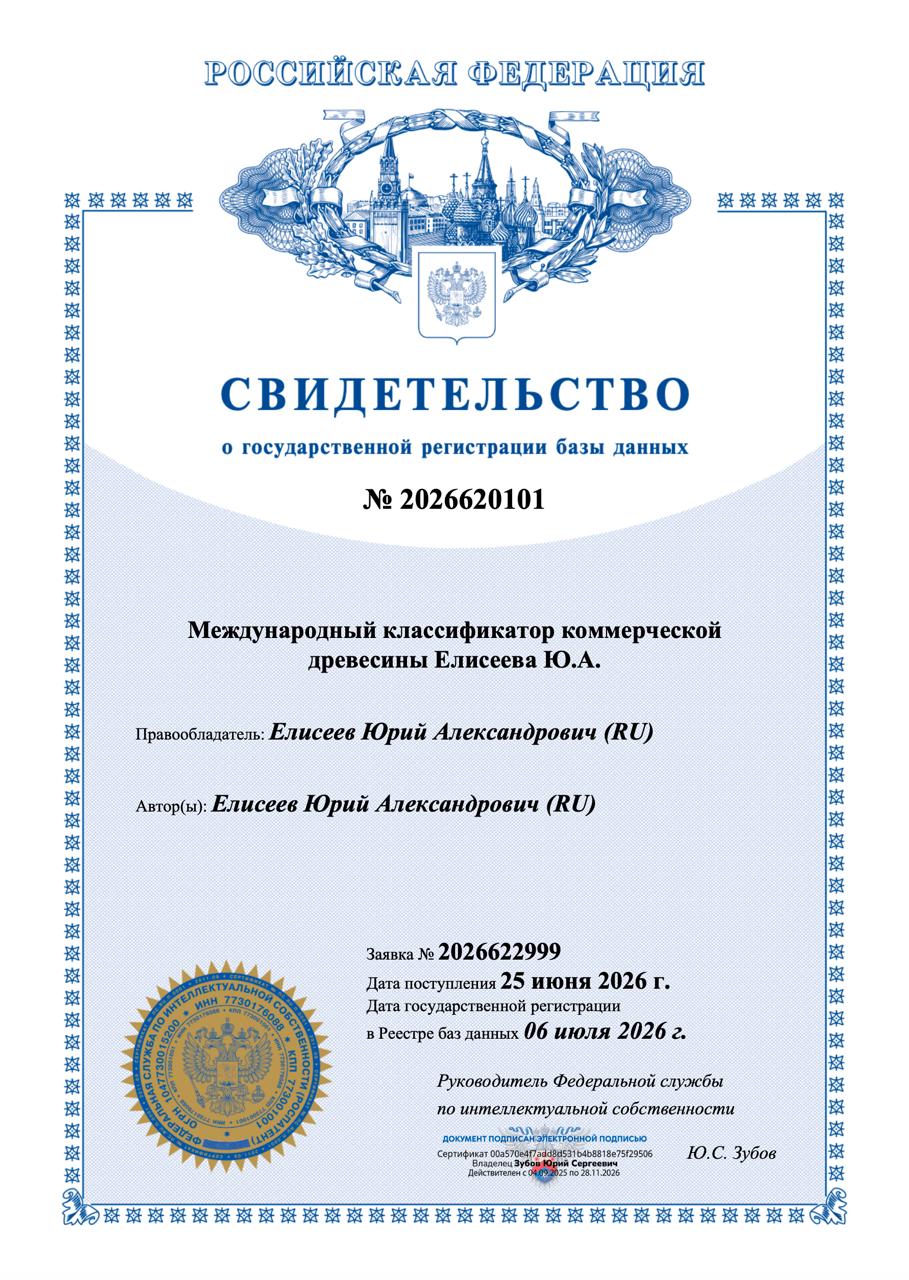
Certificate
№ 2026620101
Application
№ 2026622999
Registered
06.07.2026
State registration certificate for the timber classifier database

Database abstract

The database systematizes and standardizes information about timber species that matter in global trade. It establishes a unified description and coding system based on physical and mechanical properties, so a species can be searched, compared, classified and verified consistently rather than identified informally.

Six areas of application

From international trade to a workshop
01
Global and regional timber trade
02
Wood-processing industry
03
EUDR and CITES circulation control
04
Export/import customs procedures
05
Research and education
06
Independent woodworkers and workshops
Functional capabilities

The system standardizes records by physical and mechanical parameters; supports search and filtering; compares and classifies entries; decodes unique species codes; and provides controlled data management.

Data: does not contain personal data
Architecture: any server infrastructure
OS: Linux Ubuntu LTS 24.04
Results panel
architecture · implementation · result
UMZAR classification matrix

25 cells of commercial timber taxonomy

5 × 5 · physical and mechanical properties

Each cell combines species with a defined density and durability profile. The matrix is the basis for a unified code and reproducible verification.

Timber type:BroadleafConiferous
Density, kg/m³ →
Durability →
P1<500
kg/m³
P2500–650
kg/m³
P3650–800
kg/m³
P4800–950
kg/m³
P5>950
kg/m³
D1–P1
D1–P2
D1–P3
D1–P4
D1–P5
D2–P1
D2–P2
D2–P3
D2–P4
D2–P5
D3–P1
D3–P2
D3–P3
D3–P4
D3–P5
D4–P1
D4–P2
D4–P3
D4–P4
D4–P5
D5–P1
D5–P2
D5–P3
D5–P4
D5–P5
D1 Non-durable · <5 yearsD2 Slightly durable · 5–10 yearsD3 Moderately durable · 10–15 yearsD4 Durable · 15–25 yearsD5 Highly durable · >25 years
Examples from the database fragment
#38 · botanical name
Castanea
hardwood
Ca-4:2#2ChestnutКаштан
Density
560
Janka hardness
540
EHI
0.76
Durability index
4
#39 · botanical name
Carpinus
hardwood
Cb-1:3#3HornbeamГраб
Density
740
Janka hardness
1630
EHI
8.40
Durability index
3
#42 · botanical name
Cedrus
softwood
Ce-4:2#3CedarКедр
Density
520
Janka hardness
820
EHI
0.85
Durability index
4
#35 · botanical name
Khaya
hardwood
Kh-3:2#2KhayaКайя
Density
530
Janka hardness
800
EHI
0.86
Durability index
3
Research and engineering

How the classification becomes verifiable

The central difficulty is ambiguity: one trade name may refer to several species, while one species can appear under different names and measurement systems. The work begins with the data model and ends with a record whose features and classification can be checked.

01

Reconcile sources

Match trade and botanical names, align units of measurement and isolate ambiguous records.

Consistent records
02

Build the model

Define the taxonomy, required characteristics, record rules and a unique code for each species.

Taxonomy and code
03

Compare features

Build a comparable matrix of physical and mechanical properties and inspect the basis for classification.

Feature matrix
04

Validate the result

Check completeness and contradictions, trace feature provenance and record changes.

Auditable record

Technology and research methods

DATA · SCIENCE · R&D
ENGINEERING

Data and tools

Structured storage and reproducible record processing.

PythonpandasNumPySQLStructured databaseLinux · Ubuntu LTS
DATA SCIENCE

Analysis and classification

Species are compared by consistent properties rather than by trade name alone.

Data analysisNormalisationFeature matrixSpecies comparisonClassificationSearch and filteringCode decoding
DEEPTECH · R&D

Scientific validation

Classification rules and the provenance of each parameter must be auditable.

TaxonomyVerificationScientific validationTraceabilityReproducibilityCompleteness checksChange control

Scientific validation here means checking the source, completeness, consistency and reproducibility of records.

Have a problem that needs to become a working product?

Send the context and desired outcome. I will identify the architecture, risks and the first useful milestone.